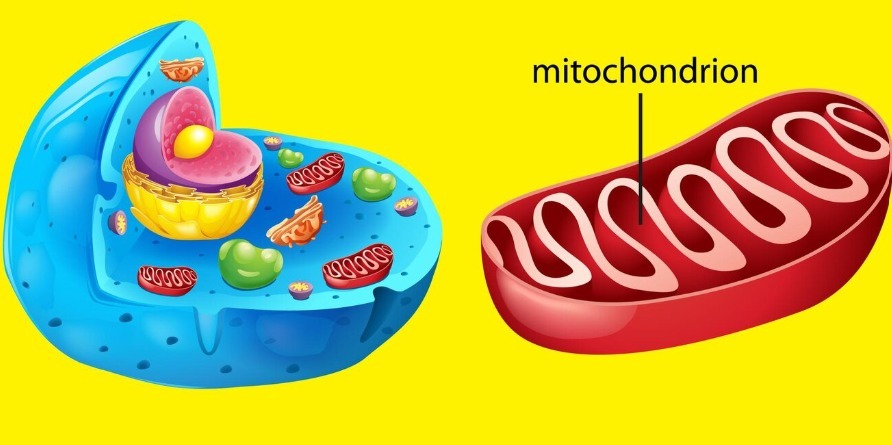
On a purely human, physical level, energy is activated in the cells through the mitochondria, little sausage looking organelles which squirm, lengthen, and change shape almost continuously.
Fluid within the mitochondria contains enzymes which break down food and release its energy. Most of the released energy is heat but some is captured to form ATP molecules.
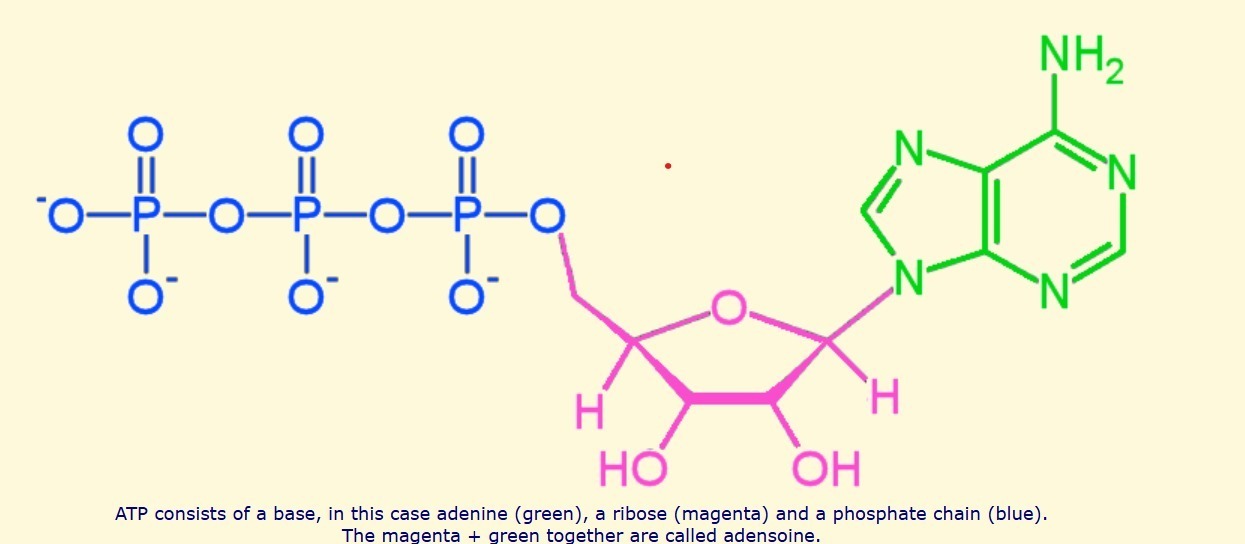
An ATP molecule is made up of chemical elements; an adenine base (green), ribose sugar (pink), and three phosphate groups (blue).
The key to how it works is in its structure. The ATP molecule is composed of three components. At the centre is a sugar molecule, ribose (the same sugar that forms the basis of DNA and RNA). Attached to one side of this is a base (a group consisting of linked rings of carbon and nitrogen atoms). In this case the base is adenine. When joined together, the sugar and base are known as adenosine. The other side of the sugar is attached to a string of three phosphate groups.
These phosphates are crucial to the activity of ATP; the chemical bonds between these phosphate groups are called high energy phosphate bonds ATP works by losing the endmost phosphate group when instructed to do so by an enzyme. This reaction releases a lot of energy, which the organism can then use to build proteins, contract muscles, generate heat, etc.
The Chinese concept of energy is interesting. Energy in Chinese is called Qi, pronounced ‘chi’ (Taichi). In Japan it’s called Ki (Reiki), and in India it’s known as Prana.
The ideogram for Qi depicts something both material and immaterial at the same time. The top and side loop indicate steam or vapour, and the bottom star section indicates uncooked rice. The concept of Qi encompasses so much more than energy because it has such a versatile nature. Qi is the driving force in the universe and our bodies and when it condenses, it can create matter.
Similarly, on a subatomic level, physical things are made up of atoms which are primarily energy.